
Robotics and AI hardware ask more of manufacturing than most plastic consumer products. Parts have to be lighter and stiffer, enclosures have to seal and shield, heat has to go somewhere, and the first small batches have to grow into volume without a redesign.
None of these demands is new on its own. What is new is getting all of them on the same product, at the same time. This is how we read those demands, and what they mean for the supplier you pick.
We are publishing the rest of this post on 25 January. Until then, these posts are ready to read now:
- The Real Cost of a Three-Month Production Delay
- Stop Selecting Injection Moulding Polymers Based on Piece Price Alone
- Where Is the Next Generation of Tool Designers Coming From?
Lighter, stiffer and cooler
Weight on a moving robot is paid for twice: once in the part, and again in the motor and battery that have to move it. That pushes designs towards die-cast aluminium, semi-solid moulded magnesium, thin-walled machined parts and glass or carbon-filled polymers. Each of those needs a supplier who can hold thin walls and still meet tolerance, and who will tell you early when a wall is too thin to fill.
AI hardware adds heat. Compute modules, motor drivers and power stages need a thermal path from the chip to the outside world: a pad or paste, a housing that works as a heatsink, and fins or airflow where the space allows. We treat that path as part of the mechanical design. That means flatness on contact faces, controlled pad compression, and a check that the finish does not insulate the very face meant to carry the heat.
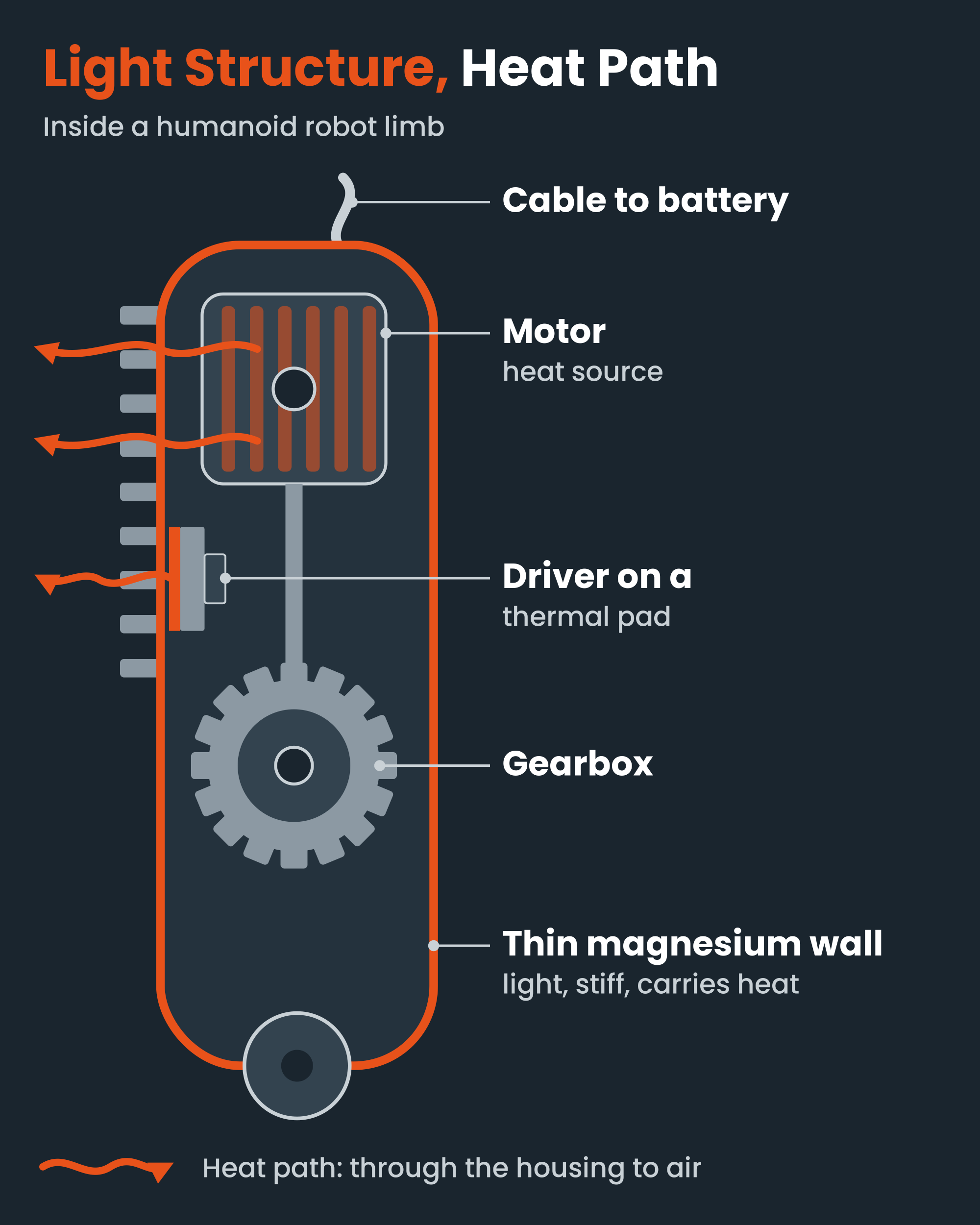
Every gram in a limb has to be carried by the motors and battery. A semi-solid moulded magnesium housing can be thin, light and stiff, and also carry heat from the motor and driver out to the air.
Enclosures that seal and shield
Many of these products live outside the clean office: on factory floors, in warehouses, outdoors or in commercial kitchens. That usually means a sealed enclosure with an IP rating, such as IP65 or IP67. The rating is only as good as the gasket, the compression and the surface it seals on, so we specify all three and agree the test method before tooling.
At the same time, the electronics need EMI shielding and grounding. A metal housing helps, but only if the joints conduct. Paint and powder coat insulate, so grounding points and EMI gasket faces need masking or a conductive finish. Sealing and shielding often compete for the same flange, so we design them together rather than one after the other.
Cable and harness routing belongs in the same conversation. Cables through a moving joint need the right bend radius, strain relief and protection from pinch points. Every cable through a sealed wall needs a gland or a sealed connector. Harnesses are often left until late, and a late harness change ripples back into housings and tooling.
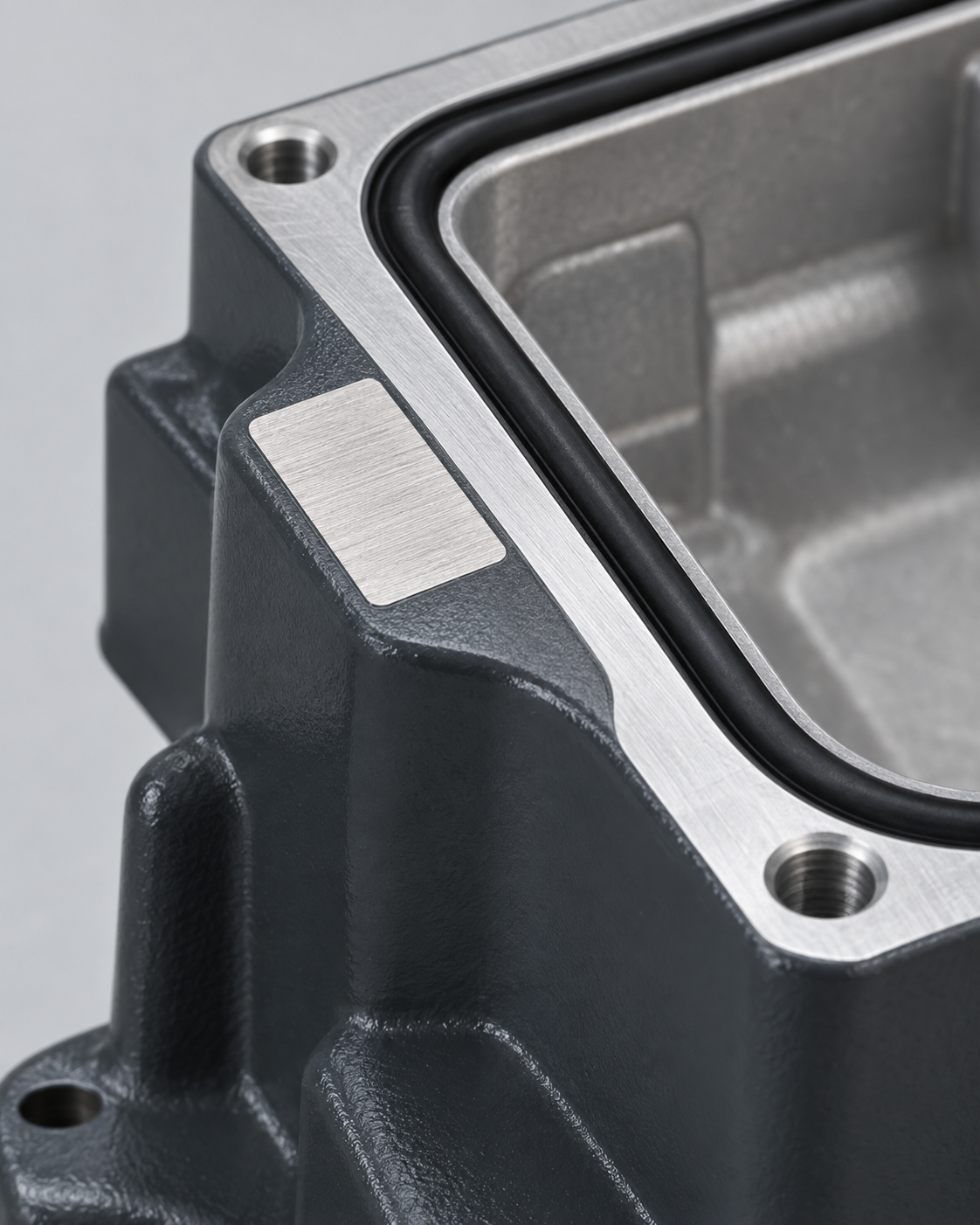
One flange, two jobs: seal out water and dust, and carry a ground through the finish.
Tolerance stacks and serviceability
A robotic assembly stacks tolerances across many parts: a bearing bore in a casting, a shaft from a machine shop, a moulded cover, a bought-in motor. Every part can be in tolerance and the joint can still bind. We work through the stack on the critical chains early, and we put the tight tolerances where they matter, often on machined faces of a cast part, rather than across the whole part.
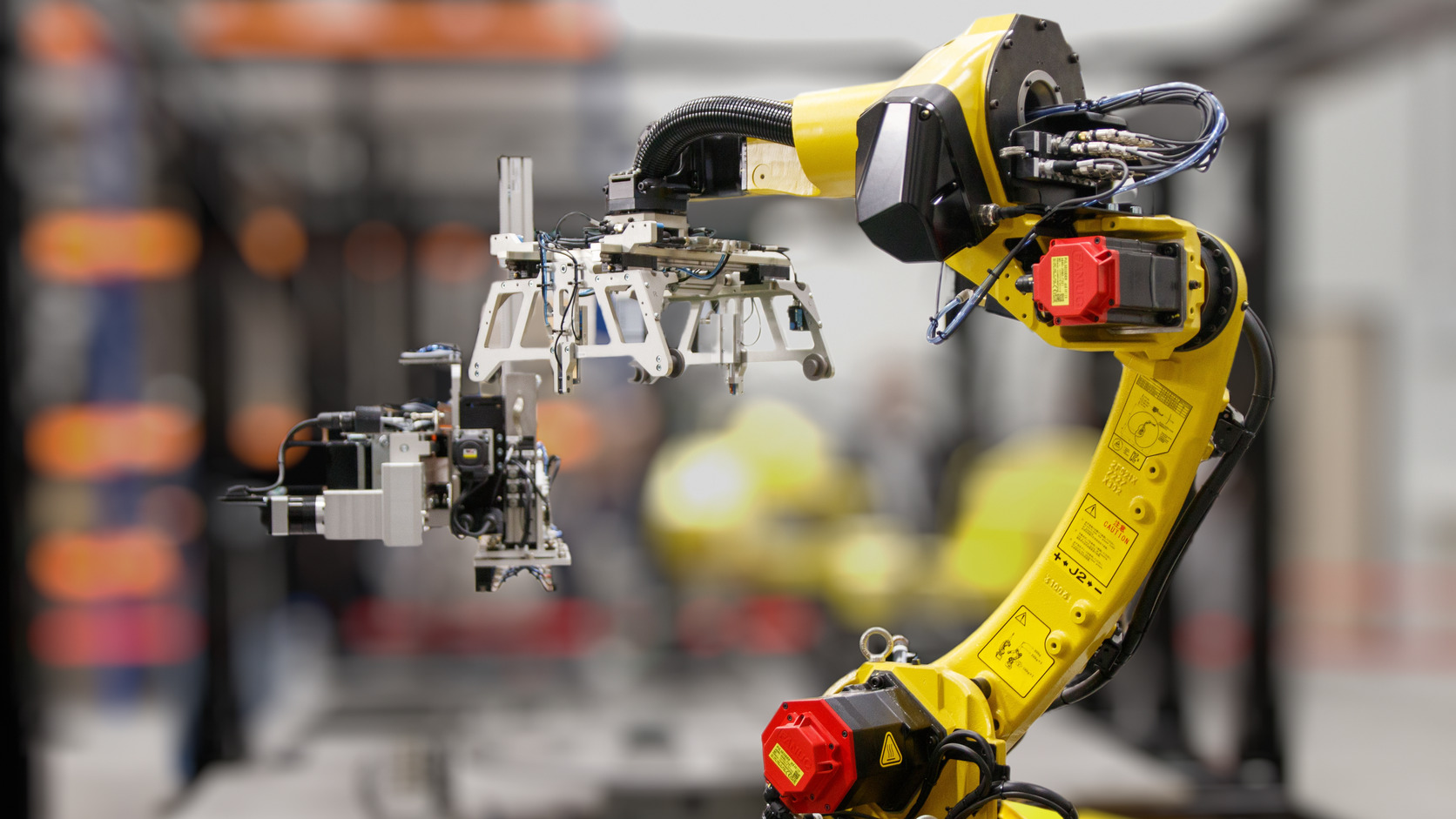
An industrial arm is a chain of joints: castings, bearings, shafts and motors that all have to stack up.
Serviceability is the other side of the same coin. Products in the field get repaired, upgraded and recalibrated. Threaded inserts rather than screws straight into plastic or magnesium, captive fasteners, connectors instead of soldered leads, and a written service sequence keep a product repairable without a trip back to the factory.
| What it means in manufacturing | What we check | |
|---|---|---|
| Low weight | Thin walls, light alloys, filled polymers | Wall thickness against tolerance and stiffness |
| Thermal management | The housing becomes part of the heat path | Flatness and finish on contact faces; pad compression |
| Sealing | Gaskets, flanges, glands and an IP test | Gasket compression, sealing surface finish, test method |
| EMI and grounding | Joints that conduct through the finish | Masking drawings; conductive contact where specified |
| Cable and harness routing | Bend radius, strain relief, sealed pass-throughs | Harness drawing frozen with the housing |
| Tolerance stacks | Precision on a few features, not everywhere | Stack on critical chains; machined datums |
| Serviceability | Inserts, captive fasteners, connectors | Service sequence and fastener strategy |
| Volume that grows | Bridge parts first, production tools later | Change control; same datums on bridge and production parts |
Small batches that grow into volume
Most of these programmes start small: a pilot build, then early production, then a ramp if the market responds. The risk is that the parts and processes that suit the pilot cannot scale, and the product needs a redesign just as demand arrives.
We plan the ramp from the first batch. CNC parts or soft tooling can carry the early builds, as long as the critical interfaces and datums match the intended production parts. Production tools follow once the design is stable. We cover how bridge parts and tooling fit together in choosing between CNC machining, die casting and injection moulding.
The parts and tools change as volume grows. The datums, interfaces and inspection method should not.
Inspection, revision control and supplier capacity have to scale too. That is where our 100% QC checks matter: the checks that protected the pilot build should still be in place at volume.
What that means for the supplier you pick
Our advice: choose a supplier for the product you will have at volume, not only for the first batch. Look for one who treats thermal faces, seals, harnesses and tolerance stacks as part of the job, and who will own the interfaces between parts rather than handing them back to you.
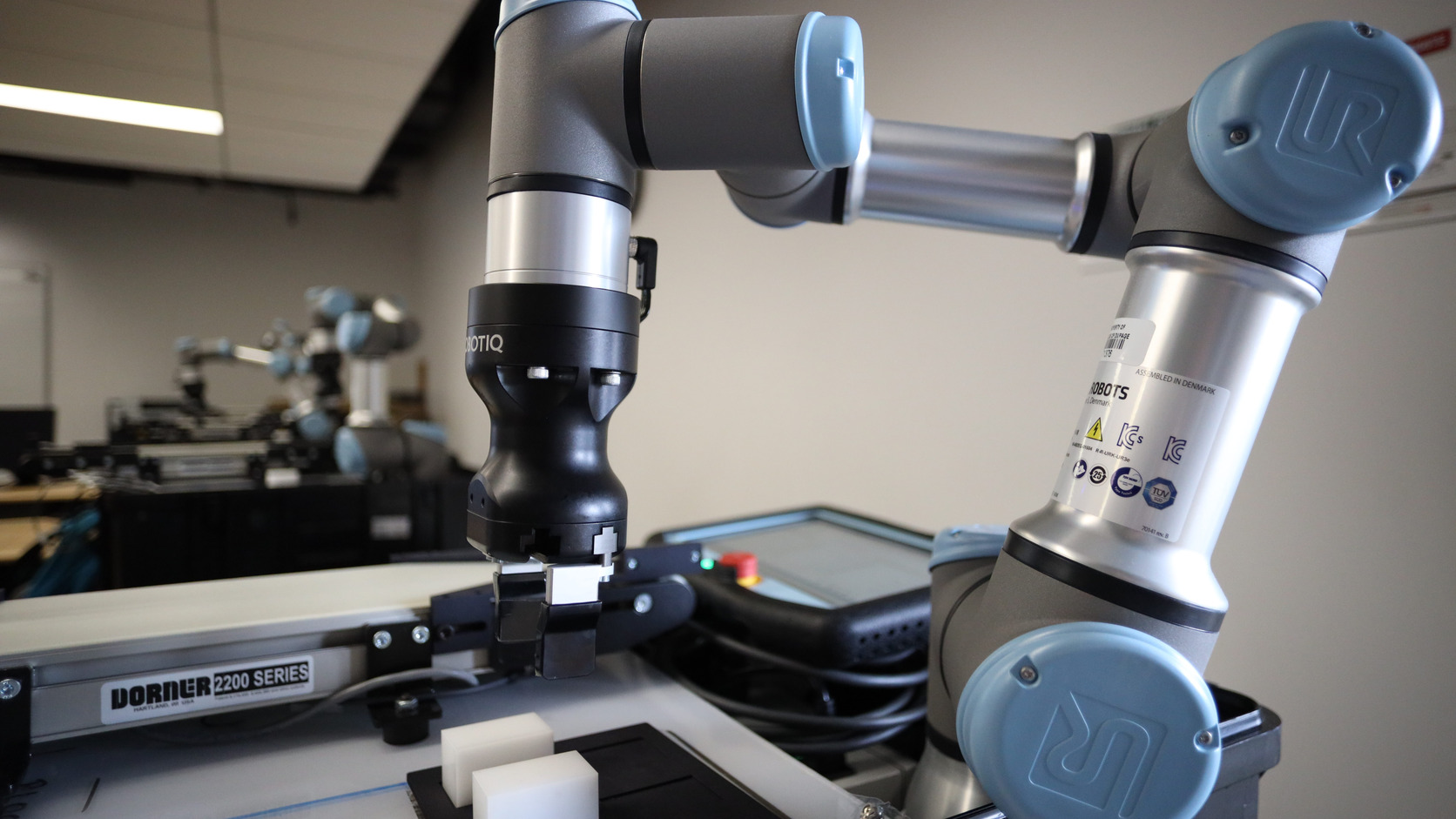
A cobot on a conveyor cell: castings, machined tubes, covers and cables from many suppliers, with interfaces someone has to own.
- DFM feedback on thin walls, draft and castings
- Thermal and sealing faces treated as critical features
- Masking, coating and plating to a drawing
- Harness and assembly owned, not just parts
- Tolerance stacks worked through with you
- Bridge parts made on production datums
- Change control that is written down and followed
- One person accountable from first build to volume