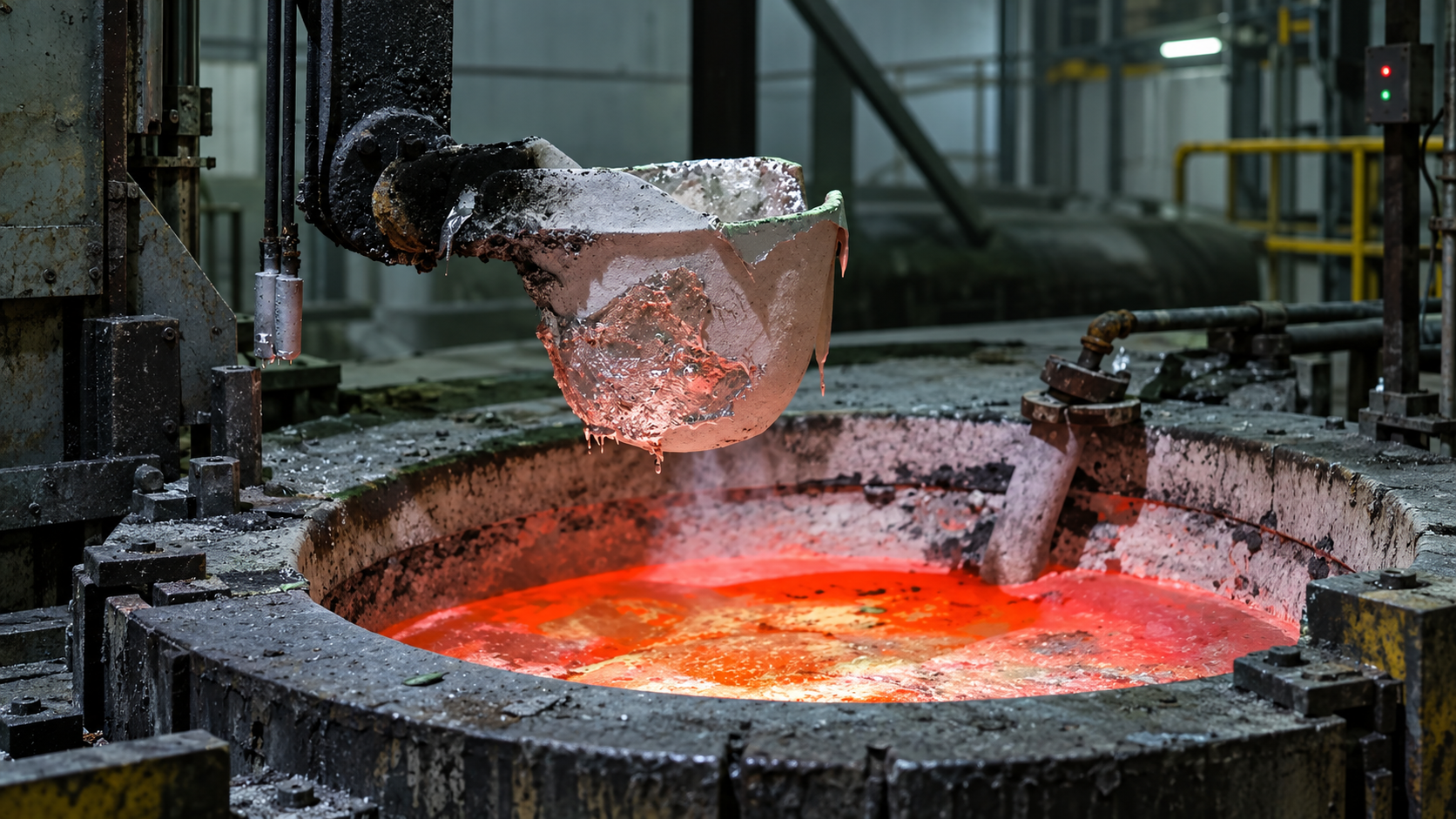
Most products reach a point where the way the first parts were made is no longer the right way to make them in production. An aluminium bracket machined from solid bar looks great in a first batch of 20. At 5,000 a year, the same bracket can quietly become one of the most expensive lines on the bill of materials.
The usual question is which process to use. We start one step earlier. The material drives the manufacturing process, not the other way round. Once you know what the part has to do and what it should be made of, the process choice narrows quickly, and volume settles the rest.
We wrote this for engineering, operations and procurement teams with a design that is ready for production. The figures are typical industry ranges, not quotes, so use them to frame the conversation with suppliers rather than to settle it.
We are publishing the rest of this post on 1 November. Until then, these posts are ready to read now:
- The Real Cost of a Three-Month Production Delay
- Stop Selecting Injection Moulding Polymers Based on Piece Price Alone
- Where Is the Next Generation of Tool Designers Coming From?
The decision in order: what the part needs sets the material, and volume then sets the process.
Step 1: What does the part need to do?
We begin with the job, not the drawing. List what the component has to survive and deliver in use: the loads it carries, how stiff it must be, the temperatures it sees, whether it needs to conduct or shed heat, whether it needs electrical conductivity or shielding, how much it can weigh, the finish the customer will see and touch, and the environment it lives in, from UV and moisture to chemicals and cleaning.
Be specific, because we will ask. “Strong” is not a requirement. “Carries its load at the end of a long arm without visible deflection” is much closer to one. These needs are what decide the material. Cost matters too, but only once the part can do its job.
Step 2: Plastic or metal?
Put the requirements side by side and most parts point clearly one way. Three examples show how we read them.
An enclosure for a handheld device usually suits plastic. It needs to be light, comfortable to hold, available in a chosen colour and texture, and often transparent to radio signals. A moulded polymer such as PC/ABS does all of that well.
A motor housing is a different story. It has to locate a bearing accurately, carry heat away from the motor and stay stiff at temperature. That points to metal, typically aluminium.
A mounting bracket sits in between. A lightly loaded bracket inside a product could be a glass-filled nylon. A bracket carrying a structural load outdoors is far more likely to be steel or aluminium.
Within each family there is a wide choice of grades, and the grade matters as much as the family. If you are working through plastics, our article on selecting injection moulding polymers goes deeper.
Step 3: How many parts do you need?
Once the material is fixed, volume decides the process.
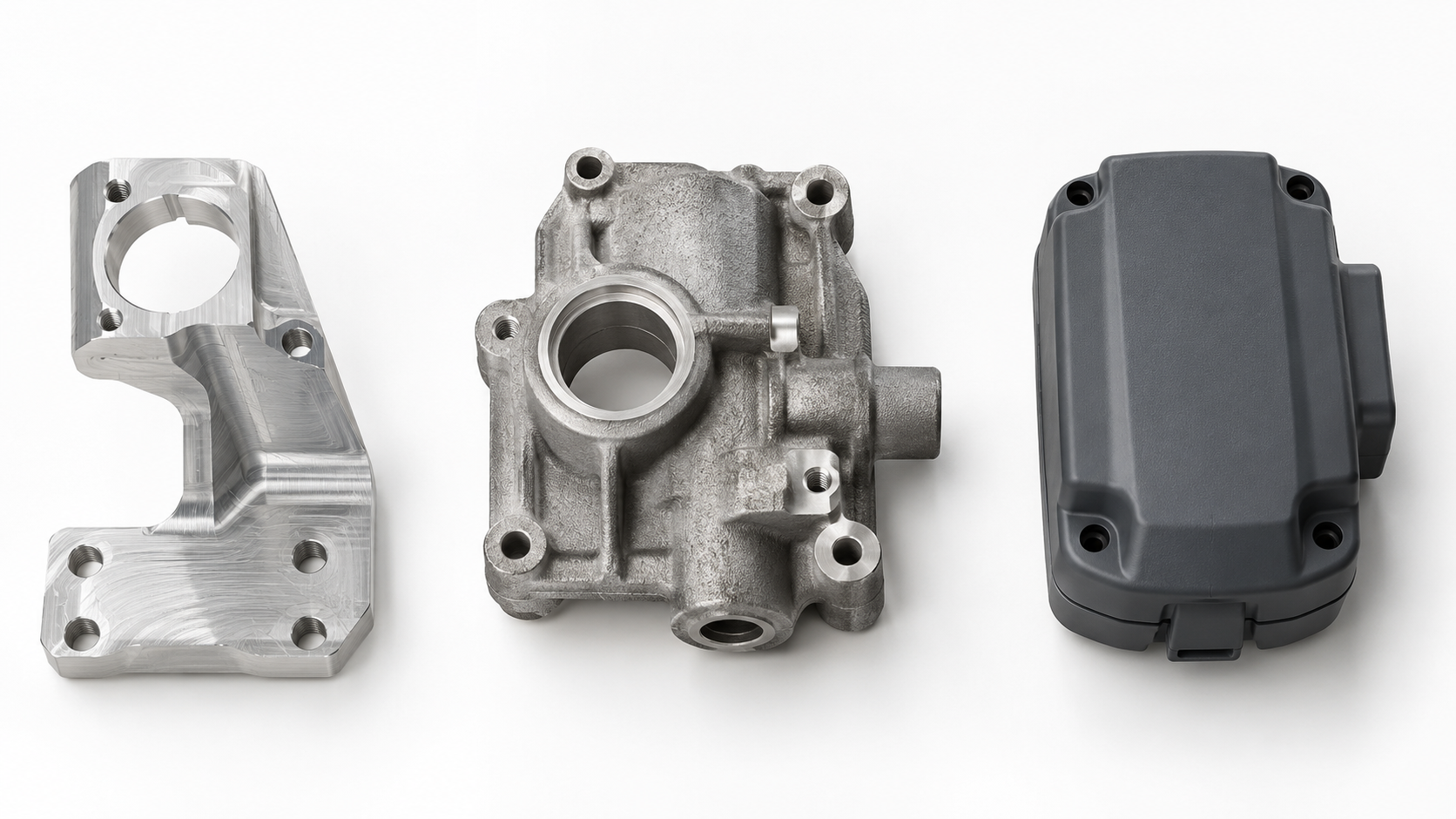
Three routes to the same job: machined from solid, cast in metal, moulded in plastic.
At the prototype stage and at very low or low production volumes, plastic and metal parts are usually CNC machined. There is no part-specific tooling to pay for, first parts can often arrive within days or a couple of weeks, and the design can change between batches. As a rough guide, CNC is often the sensible route from a single part up to a few hundred a year, and sometimes into the low thousands for small, simple parts.
Past that point, the cost of machining every part from solid starts to outweigh the cost of a tool, and the route splits by material.
Plastic parts go to injection moulding
Injection moulding is the production route for plastic. A mould tool can range from a few thousand pounds for a simple aluminium tool to tens of thousands for a multi-cavity hardened steel tool. In return you get a low, consistent cost per part, short cycle times, and colour and texture straight from the tool. It typically pays back from a few thousand parts upwards.
Metal parts go to die casting or another metal route
Leaving aside metal injection moulding, a specialist process for small, intricate parts, metal takes a different route at volume, and the shape of the part decides which. Die casting suits complex three-dimensional parts such as housings, usually in aluminium or zinc alloys (Zamak), and typically starts to make sense in the low thousands per year. Magnesium parts take a route between die casting and plastic injection moulding: semi-solid injection moulding, often called thixomoulding, where the alloy is heated to a thick slurry and injected into a mould much as a plastic would be. Flat brackets and clips are often stamped or pressed from sheet. Forging suits highly loaded parts that need strength through the material. Extrusion suits long parts with a constant profile, such as rails and heatsinks.
These volume bands overlap on purpose. Part size, complexity and material all move the crossover points, so we always ask for quotes at two or three volumes and see how the unit price moves.
Indicative only. Once the material is chosen, this is what volume does to cost: CNC stays fairly flat, while tooled processes start high and fall below it as volume grows. Where the lines cross depends on the part.
| CNC machining | Die casting (HPDC) | Injection moulding | |
|---|---|---|---|
| Material | Plastic or metal | Metal only: aluminium or zinc (Zamak) alloys | Plastic only: thermoplastics |
| Typical grades | Aluminium: 6061-T6, 7075-T6; EN AW-6082 common in EuropeMild steel: Q235B / S235JR / 1018, 45# / C45 / 1045Stainless: 304, 316/316LBrass: free-cutting gradesPlastics: POM (acetal), nylon PA6/PA66; PEEK for high-temperature/chemical or specialised applications | Aluminium: ADC12 (China/Asia, ≈ EN AC-46100 / A383), A380 or EN AC-46000 (AlSi9Cu3, common US/EU)Zamak 3/5 (zinc; ZP3/ZP5 in Europe) | ABSPP (including talc-filled)PC/ABSNylon PA6 (and glass-filled)POM (acetal)and many others |
| Typical volume band | 1 to a few hundred a year, sometimes low thousands | Low thousands to hundreds of thousands a year | A few thousand to millions a year |
| Part-specific tooling | None beyond simple fixtures | Hardened steel die, often the highest tooling cost of the three | Aluminium or steel mould, from a few thousand pounds to tens of thousands |
| Unit cost trend | Relatively flat as volume rises | Falls steeply once tooling is paid back | Falls steeply, usually the lowest at high volume |
| Lead time to first parts | Often days to a couple of weeks | Typically 8 to 16 weeks including the tool | Typically 4 to 12 weeks including the tool |
| Tolerances and finish | Tight tolerances achievable; machined finish, then anodise or coat | Moderate as cast; critical features often machined after; good base for powder coat | Good repeatability, limited by material shrinkage; texture and colour can come from the tool |
| Design freedom | Limited by cutter access; internal corners need radii | Complex shapes and thin walls; needs draft and even wall thickness | Very complex shapes, clips and bosses; needs draft; undercuts add tool cost |
| Choose it when | Prototype or low volume in either material, or a changing design | Complex metal part, steady volume, stable design | Plastic part, higher volume, stable design |
Step 4: When should you switch, and how do you bridge?
CNC is often the right place to start, and it is easy to stay there too long. The warning signs we look for are usually commercial. The unit price barely moves as order quantities grow. A lot of material is being cut away from solid. You are paying to machine features, such as ribs or pockets, that a tool would form at no extra cost per part.
When those signs appear and demand is steady, quote the tooled route for your material. Expect some design changes, because cast and moulded parts need draft angles, even wall thicknesses and generous radii. The design also needs to be stable and reviewed for manufacture before steel is cut, because changing a tool afterwards is slow and costly. Tool lead times are typically several weeks to a few months, which is why the real cost of a three-month production delay is worth understanding.
Bridging lowers the risk, and it is how we would plan most switches. Many programmes run CNC parts for the first production batches while the tool is being made, then switch once the tooled parts are approved. Aluminium moulding tools can cover lower volumes before a full steel tool is justified. Die cast housings often have their bearing bores and sealing faces machined afterwards, so the processes work together rather than competing. Keep the interfaces and critical dimensions the same on the bridge part and the production part, and the switch is far smoother for assembly, testing and quality checks.
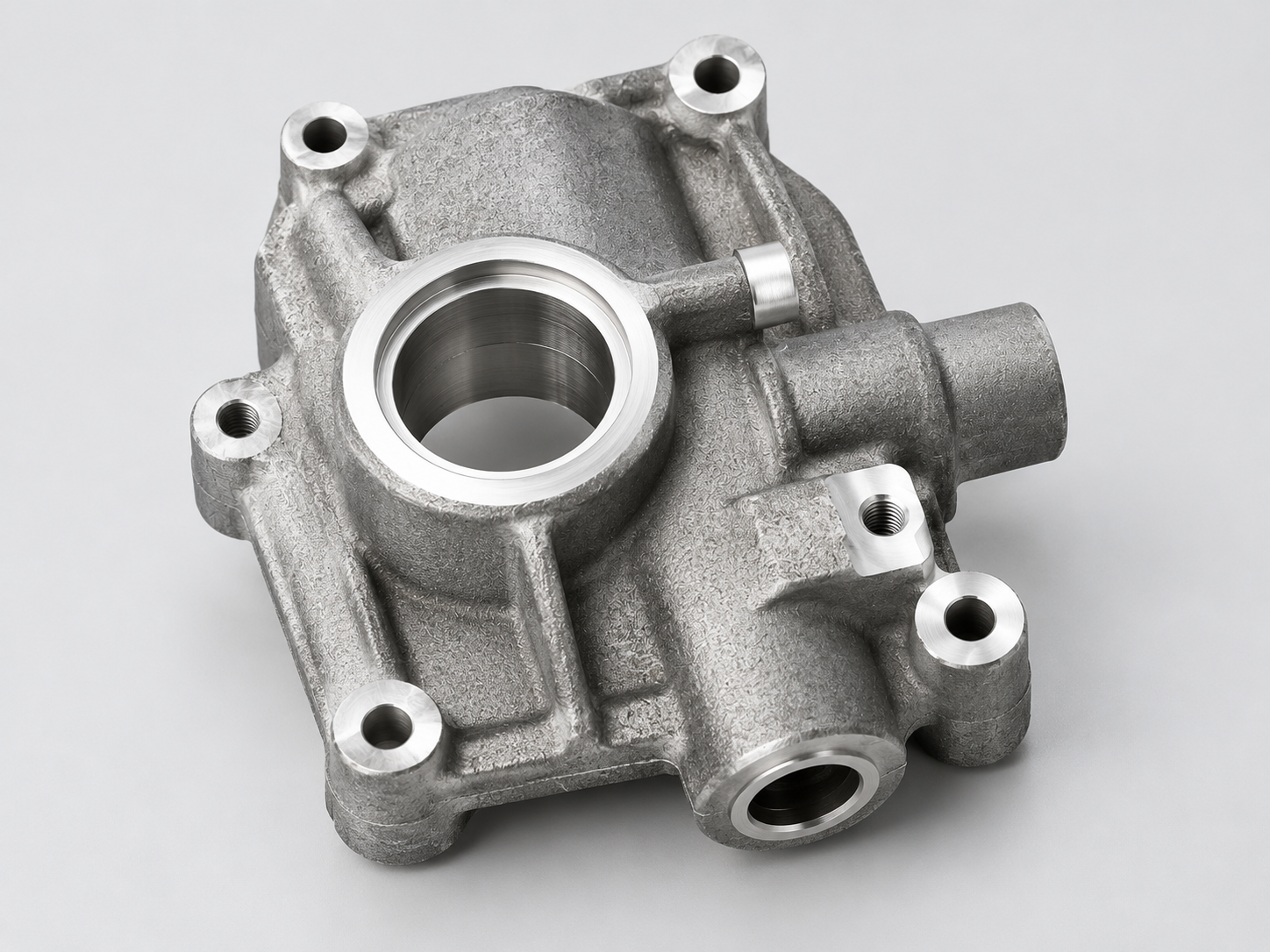
Casting and machining often work together: the casting forms the shape, machining finishes the critical features.
- Material first, process second. Let what the part needs choose plastic or metal before you compare processes.
- Below a few hundred parts a year, CNC machining usually suits both plastic and metal.
- Past the volume break, plastic goes to injection moulding; metal goes to die casting, stamping, forging or extrusion depending on shape.
- Spread tooling cost over the volume you are confident of, not the forecast you hope for.
- Freeze the design and complete a DFM review before any tool steel is cut.
Making the call
Our advice: work in order. What the part needs, then the material, then the volume. Get quotes for the realistic routes at your real volumes, compare the total cost per part including tooling, finishing and inspection, and ask each supplier what would need to change in the design to suit their process.