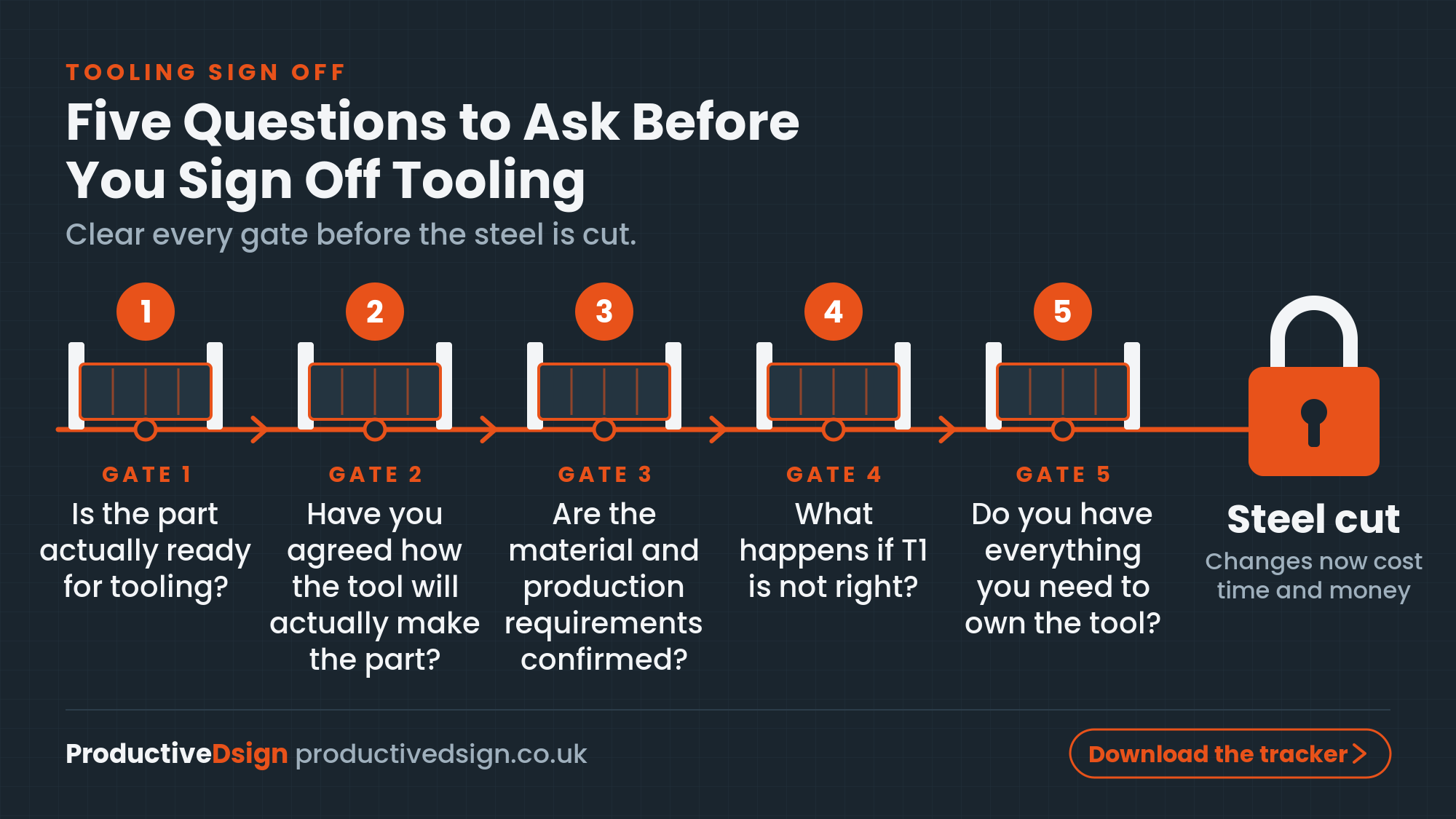
Once steel is cut, changing your mind becomes considerably more expensive.
Signing off production tooling, whether that is an injection mould or a die-casting die, is one of the biggest decisions in a product programme. It is also where the pressure to move quickly is highest. The tool has been quoted, the design has been reviewed and the programme is moving, so the temptation is to approve the tool and get started.
Before we sign off any tool, we ask five questions.
We are publishing the rest of this post on 14 December. Until then, these posts are ready to read now:
- The Real Cost of a Three-Month Production Delay
- Stop Selecting Injection Moulding Polymers Based on Piece Price Alone
- Where Is the Next Generation of Tool Designers Coming From?
1. Is the part actually ready for tooling?
It sounds obvious, but it is the question we ask first. Have the critical design decisions been resolved? We check:
- Material and production grade
- Wall thickness and transitions
- Draft
- Parting line
- Gates and runners
- Ejection
- Critical dimensions and tolerances
- Assembly interfaces
- Cosmetic requirements
Not every detail needs to be fixed forever. The toolmaker may deliberately design some areas steel safe or leave room for adjustment after T1. What matters to us is knowing what has been left open on purpose, and why, rather than carrying unresolved design questions into the tool.
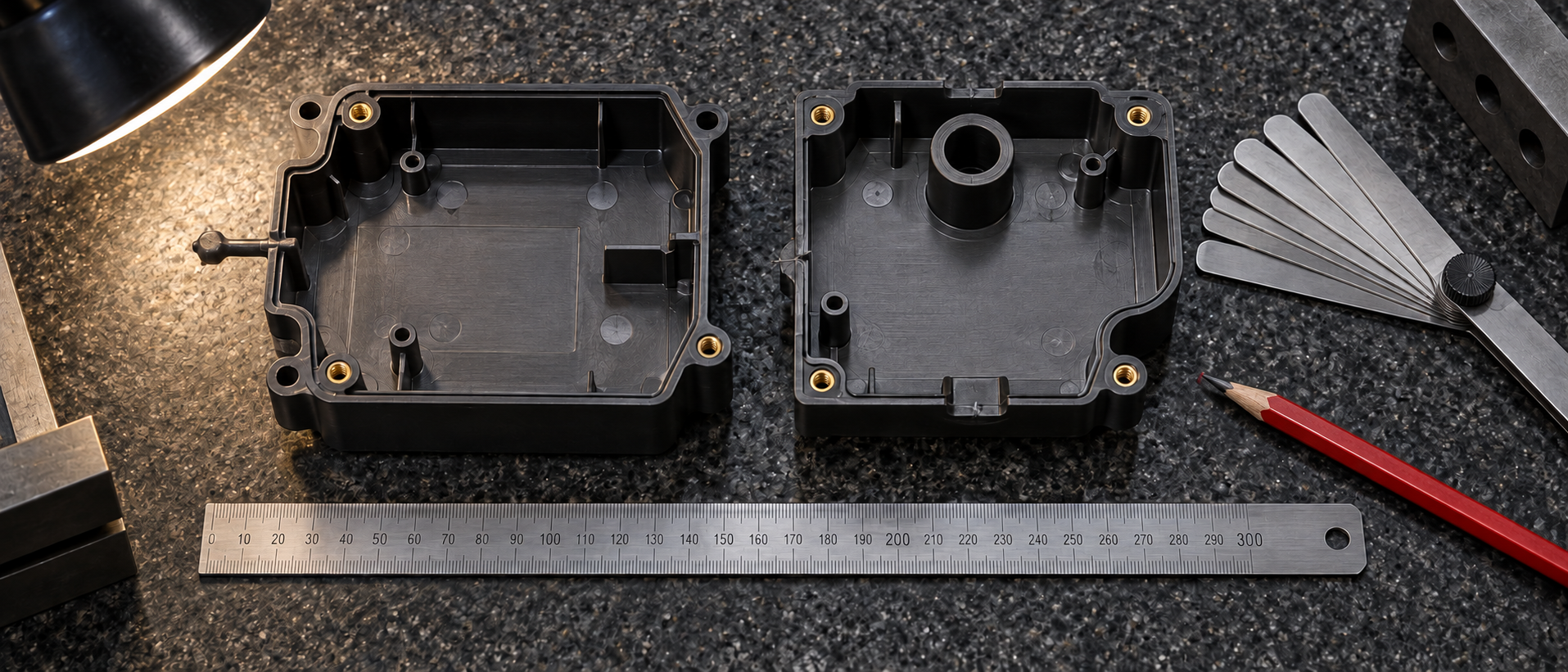
Parting lines, gate vestige, draft and steel-safe witness areas should be conscious decisions before tool sign-off, not surprises at T1.
2. Have you agreed how the tool will actually make the part?
A good tool does more than reproduce the CAD geometry. We treat the manufacturing process as part of the tooling decision.
Where is the material going to enter the cavity? How will the part fill, how will it cool and where will it be ejected? Could the proposed gate position affect appearance, warpage or weld lines? Is the cooling strategy realistic for the required cycle time?
For more complex components, mould-flow analysis, or casting simulation for a die-cast part, helps us understand filling, packing, cooling and potential warpage before steel is cut. We are not trying to remove every possible risk before tooling. We want the important risks understood while there is still time to change the design or the tooling approach.
3. Are the material and production requirements confirmed?
We want the tool designed around the material you actually intend to use in production. Not simply “PA66”, “PP” or “ABS”, or a generic aluminium alloy.
The specific production grade can affect shrinkage, processing conditions, cooling, surface appearance and dimensional behaviour.
The same applies to the production requirements: the volume the tool is expected to produce, the target cycle time, the number of cavities, the machine it will run on, the tool life expected and whether the tool will move between suppliers or regions during its life.
These decisions can change the tool design significantly, and changing them later is rarely straightforward.
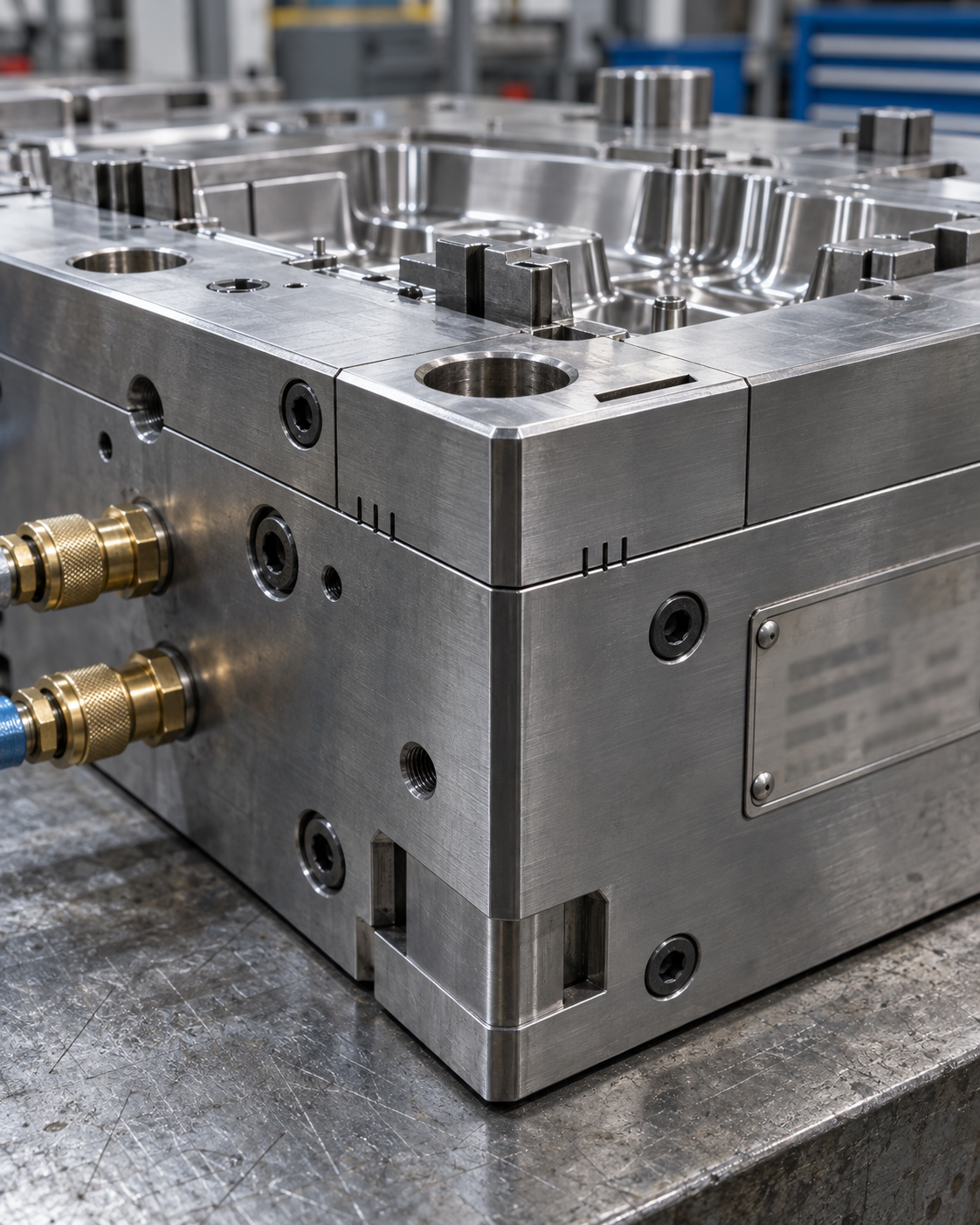
Production grade, cavitation, cooling circuit layout and tool life dictate the steel specification from day one.
| Requirement | What it drives in the tool |
|---|---|
| Volume and tool life | Steel grade and hardness, how the tool is built and how it will be maintained |
| Target cycle time | Cooling layout and how hard the cooling circuit has to work |
| Number of cavities | Tool size and cost, and the size of press or casting machine needed to run it |
| Machine it will run on | Tool footprint, mounting and the clamp force available |
| Moves between suppliers or regions | Documentation, standard parts and identification, so the tool stays transferable |
4. What happens if T1 is not right?
This is the question that gets skipped. Everyone wants the first tool trial to go well. But what happens if it doesn’t?
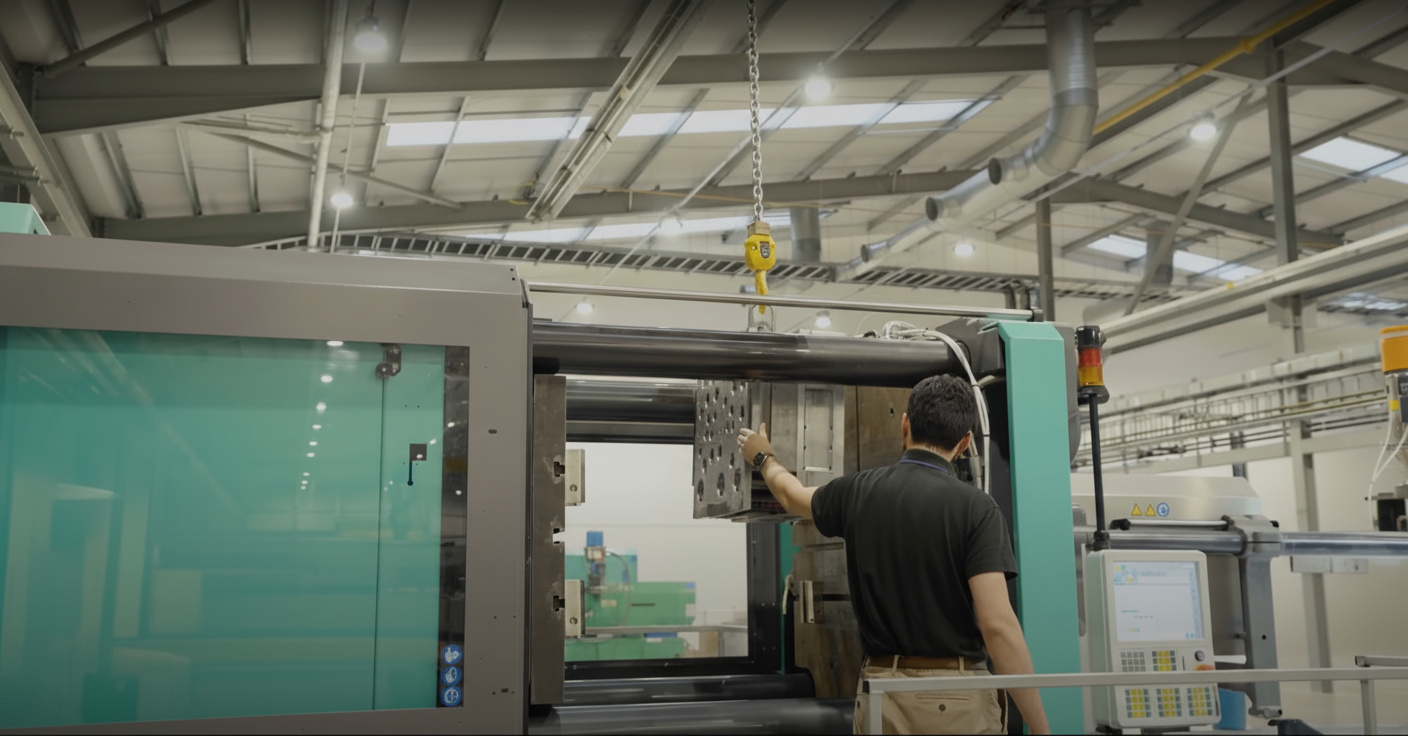
A mould going into the press. T1 is where the tool meets real material, so agree in advance what will be measured.
Before we sign off a tool, we want the T1 process agreed in writing. What will be measured? Who will attend or review the trial? What constitutes an acceptable result? How will modifications be agreed, and who owns the cost of different types of tooling changes? And how much time has been allowed for T1 modifications and further trials?
The T1 loop. Agree before sign-off what will be measured, what counts as acceptable and how modifications and re-trials will be handled.
We are not assuming the tool will fail. We just want a plan ready if reality does not match the CAD model.
5. Do you have everything you need to own the tool?
A tooling project does not end when the supplier produces good parts. The tool may need to be maintained, modified or moved during its life, so you need the information to manage it. This is what we ask for:
- Tool drawings
- 3D tool data
- Steel specifications
- Component and standard-part information
- Spare parts
- Maintenance requirements
- T1 and validation records
- Modification history
- Tool photographs
- Identification and ownership details
This matters most when tooling is made overseas or production may move between suppliers. Our rule is simple: the tool should stay understandable and transferable throughout its life.
Don’t confuse approval with certainty
No tooling sign-off can remove every risk. There will always be things that only become clear when the tool produces real parts.
So a good tooling review is not about absolute certainty. It is about making sure the important decisions are made, the known risks are understood and there is a clear plan for what remains.
- Is the design ready?
- Is the manufacturing approach understood?
- Are the material and production requirements confirmed?
- Do we have a plan for T1?
- Can we manage the tool throughout its production life?
If the answer to all five is yes, you are in a much stronger position to cut steel.
At ProductiveDsign, we work across product design, DFM, tooling and production to help make those decisions before tooling begins. The easiest time to change a tooling decision is before the toolmaker starts cutting steel.